
Leading Local kicks off civic workshop series
By Gabriel Hathaway, Winona Post
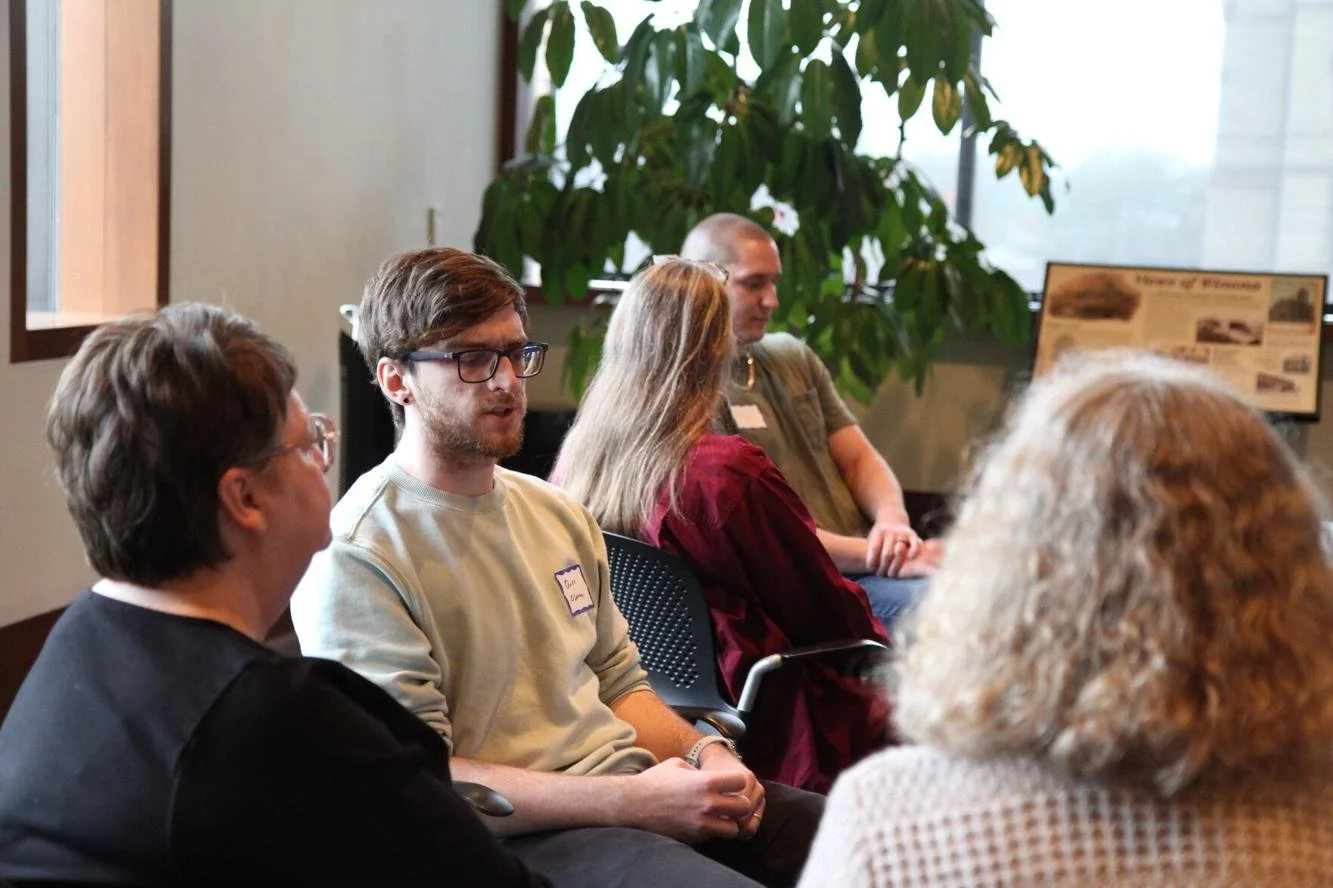
Photo by Gabriel Hathaway
Quinn O’Connor (center) talks with other community members about what he likes about Winona and what he wishes were different at Engage Winona and the Winona Post’s Local Government 101 workshop on April 14.
Who decides what roads get fixed, what is in the budget, and which ordinances pass? The inner workings of government can often be a confusing puzzle, but last week, Engage Winona and the Winona Post partnered on a workshop to explain the operations of local government and how to get involved. “I think it's especially important on a local level [to be engaged] because you really can make a difference … You really can change the outcome of things,” Winona Post Editor Chris Rogers said.
On April 14, Engage Winona and the Winona Post hosted a Local Government 101 workshop. It is the first of many upcoming workshops and other events the two organizations are offering under the umbrella of Leading Local. Engage Winona Program and Communications Manager Isabel McNally said, at its core, the Leading Local partnership is about civic health, meaning, “... creating communities where people can contribute, they can collaborate, and everyone feels like they have something of value to share in this community, because they do,” McNally said. “And kind of creating those structures for everyone to feel like they do have power and voice and they know how to use it should they wish to.”
At last week’s workshop, McNally and Rogers shared various resources about local governments, contact information for elected officials, and more. They also explained the various layers of local governments, including the county, which administers state health and human services programs, and handles rural zoning and roads; city government, which administers zoning codes, manages parks, provides utilities like water and sewer, and funds first responders like police and firefighters; as well as school districts, which manage education policy, funding, and facilities. There are additional layers of decision-makers in each government. While elected officials such at the City Council, School Board, or County Board generally meet twice a month to make large decisions, such as on budgets or agreements, government employees keep the day-to-day operations working, administer programs and services, make smaller decisions, and bring recommendations to elected and volunteer bodies. Finally, volunteer boards and commissions may be focused on specific issues and make some decisions and provide recommendations to the City Council.
Attendee Anna Sibenaller said the workshop provided a lot of helpful information. “This kind of information is something that is glazed over in primary education because there are lots of things to learn,” Sibenaller said. “So a lot of times adults find themselves wondering how to affect the world that they live in and the things that affect them day to day,” Sibenaller said. That lack of understanding can lead to confusion, which can make people upset, attendee Laura Armstrong said. Learning more about how things work and which government does what is important, Armstrong said, adding, “When they have an entry point, they feel like they have power.”
At the workshop, Armstrong said that while she tries to stay educated, paradoxically, she feels like she knows more about federal rules than local rules. McNally said that’s not uncommon and that many people tune into state and federal issues more than local ones. She noted that 95% of elected offices are local, 70% of which are uncontested in Minnesota. While one big way to get involved and affect local change is to run for office, McNally and Rogers said there are plenty of other ways too. This could include simply attending meetings of elected bodies, speaking up during public hearings, talking to your representative, volunteering for a board or commission, reading the news, or talking about local issues important to you with others. “The option is not to run for local office or do nothing. There are all these ways to plug in, to connect where you are,” McNally said.
Although the feeling that a person cannot make a difference is often a hurdle to civic engagement, Rogers said people can affect local change, especially if they come together around an issue. As an example, he noted that outdoor enthusiasts formed groups such as the Winona Area Mountain Bikers (WAMB) and Recreation Alliance of Winona (RAW) and now the city seeks out their input about city trails and parks. WAMB and RAW also have agreements with the city to maintain Bluffside Park, as well as Sugar Loaf Park and Winona Ice Park, respectively. "It doesn't always work out in your favor, and sometimes it takes a whole heck of a lot of work and a lot of people pulling in the same direction to change things, but it's possible, and I've seen it happen,” Rogers said.
More information about Leading Local and upcoming events is available online at www.engagewinona.org/leading-local.
This article was orignally published in the Winona Post, you can find the source material at https://www.winonapost.com/news/leading-local-kicks-off-civic-workshop-series/article_022cbe63-c036-41d6-9317-26743a7ec00a.html