
Winona Housing: A Community Snapshot
MN Storycollective Housing Sensemaking Session - Winona Housing Fact Sheet
Held on March 14, 2026
Hosted by Engage Winona, a 501c3 nonprofit cultivating stronger communities in southeast Minnesota by reigniting community participation through dialogue, support, and training. We are working to build a culture where people come together to envision the community’s future and stay together to create it.
People want to put down roots in Winona County, and the stories our neighbors share make that clear. 80% of Winona County community members who participated in the 2025 MN StoryCollective initiative raised concerns about housing stability or affordability.9 A pattern like that doesn’t just describe a problem – it points us toward our greatest opportunity to invest in each other. This fact sheet is our invitation to think big together.
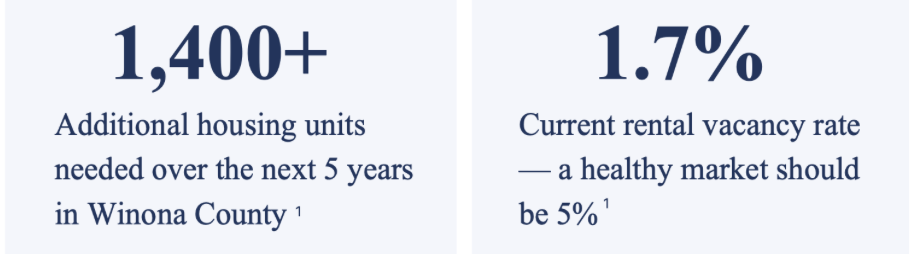
Winona needs more housing of all kinds
Like many communities across the United States, Winona County faces a housing shortage that touches everyone: families, seniors, workers, and businesses. Understanding the scale of the challenge is the first step toward solving it.
What's included in that 1,400+ units? The 5-year need includes 180-190 subsidized senior housing units, 420-440 subsidized housing units, and 555 additional units (single-family homes, market-rate rentals, and more). An additional 70 subsidized and 120 market-rate units are needed over 10 years. 1
The roots of the current housing shortage trace back to zoning decisions made in the 1950s and 60s. Post-war development focused almost exclusively on single-family homes and large apartment buildings, leaving out the range of mid-sized housing in between.5 This “missing middle” was effectively made illegal through zoning codes, and Winona's supply has quietly shrunk ever since.
Meanwhile, Winona’s demographics are changing. In 1960, the average household size in Winona was 3.08. In 2020, it was 2.26 3. As more people live alone or with a small number of people, we need more housing to meet the demand of a stable population. If we do nothing, demographics alone will make us effectively run out of housing. 6
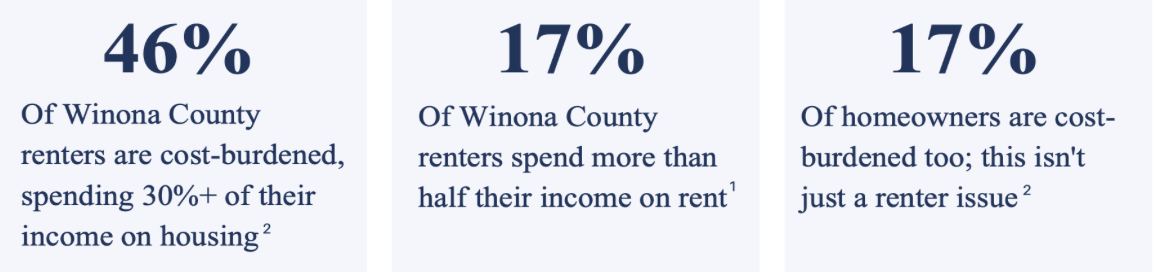
When people can't afford to stay, everyone feels it
Housing isn't just a personal concern – it's the foundation of a healthy community. When working families can't find a home they can afford, they leave. When older adults can't find right-sized housing, they’re stuck. When workers can't move here, businesses can't grow. The ripple effects touch every aspect of our communities.
Possibilities
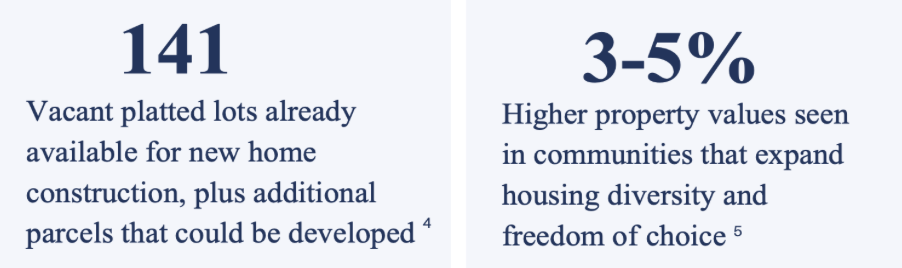
Our region already has what so many communities are trying to build: walkable downtowns, natural amenities, cultural richness, and a strong sense of place. There are 13,000 people who commute into Winona every day, 7 many of whom would love to invest in this community by living here. Add to that a growing wave of remote workers leaving cities in search of places like Winona, and the demand is clear. Small cities with tourism hubs are increasingly where people want to live.
Opportunities
Restore the freedom to build missing middle housing. Update zoning to allow more housing options, giving families and individuals more choices while honoring the scale and character of Winona's neighborhoods. This includes backyard cottages or ADUs, duplexes, and more.
Give older adults the choice to right-size. Just one or two new affordable senior housing buildings can unlock a chain reaction, freeing up homes for first-time buyers and allowing seniors to choose a lifestyle that fits their lives.8
Activate underused spaces downtown. Rezoning and underused parcels and developing upper floors of commercial buildings creates new places for people to live and invest, strengthening the whole community in the process. Rehabbing older buildings and housing stock additionally builds desirable supply, keeping homes in communities. 10
1 Comprehensive Housing Needs Analysis for Winona County, 2024. Pages 6,7,8.
2 Minnesota Compass - Winona County Cost Burdened Households by Type, 2019-2023.
3 Winona Baseline Report of the 2045 Comprehensive Plan, 2024. Page 10
4 Winona County Housing Study, 2024, Page 21.
5 City of Winona 2045 Comprehensive Plan, 2024. Pages 4-5, 5-8.
6 Rewriting the Rural Narrative, 2025.
7 City of Winona Commuting Data for all Jobs, 2019.
8 The Workforce Housing Shortage: Getting to the heart of the issue, 2018.
9 2025 MN Storycollective Comparative Housing Cost / Stability Indicator, 2025.